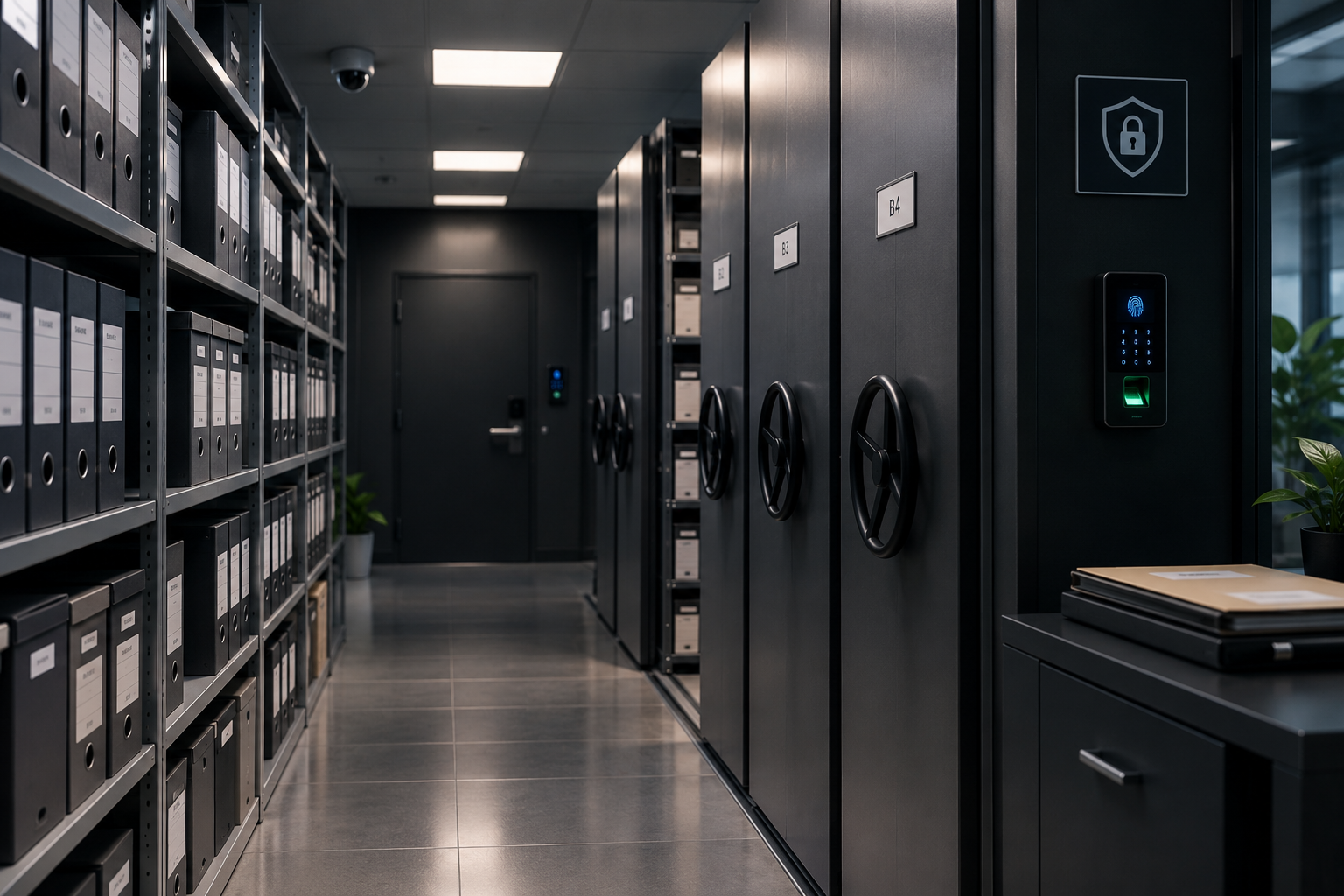
In Congo-Brazzaville, as elsewhere, the modernization of administrations and businesses now depends on the way information is produced, stored and shared. Dematerialization, which consists in gradually replacing paper with digital documents and processes, holds an increasingly central place in this evolution, because it affects the efficiency of services, the security of data and the country’s ability to build on its own archives.
A paper-based model that shows its limits
For decades, administrations and businesses across the country have worked almost entirely with physical documents, and this model long met everyone’s needs. As volumes and exchanges grow, its limits become more visible, and they start with the fragility of the medium itself. Paper suffers from humidity, dust, heat and insects, it remains exposed to fire and flooding, and the loss of an original document can deprive an organization of an administrative, legal or historical record that is sometimes impossible to reconstitute.
Finding information is a second source of difficulty. Locating a file in stacked boxes or old registers takes time and staff, which weighs on the productivity of teams in Brazzaville, in Pointe-Noire and in the rest of the country. Costs add to this and recur from one year to the next, whether it is the purchase of paper, printing, the reproduction of documents or the space needed to store volumes that keep growing, resources that could otherwise go toward developing the activity itself.
What dematerialization brings
The first benefit is access to information. A contract, a decree, a civil status record or a personnel file that has been digitized and properly indexed can be found within moments from a name, a date or a keyword, and it can be consulted without anyone having to travel to the place where the original is stored. For an agent or an employee based in Ouesso or Dolisie, this means obtaining a document without a trip to the capital, with the savings in time and money that follow for staff and users alike.
The second benefit concerns traceability and governance. In an electronic document management system, each file carries a history showing who consulted it, when and, depending on the configuration, for what reason, which makes it possible to restrict access to authorized people and to reconstruct the path of a document when needed. This transparency strengthens trust between departments, partners and users, protects sensitive information and contributes to a clearer business environment.
The third benefit is the durability of information. A digital archive does not preserve itself, since it depends on the quality of the digitization, the lifespan of the storage media and the existence of copies kept in separate locations. When these conditions are met, however, it offers a protection that paper cannot provide on its own, because a copy kept apart from the original makes it possible to recover a document even after a disaster, and it is in this sense that dematerialization acts as an insurance for the technical, financial and cultural memory of organizations.
What it changes for each group
For businesses, dematerialization makes it possible to better protect their essential documents, to gradually free up office space taken by archives and to respond faster to clients, partners and inspections, since the requested records can be found without delay. It also makes collaboration easier between teams spread over several sites, which is useful for organizations present in both Brazzaville and Pointe-Noire.
For administrations, it opens the way to a faster and clearer public service, in which users’ procedures go through fewer physical steps and files remain available from one department to another, which answers citizens’ expectations in terms of timeframes and clarity.
For citizens, it translates into simpler procedures and into the assurance that their official documents, once digitized and secured, remain available and protected over time, without depending on the condition of a register or a storage room.
A transition to be carried out with method
Dematerialization is not limited to buying a scanner. It requires listing the existing documents, defining a filing plan, drawing up a retention schedule that sets how long each type of document is kept, choosing a suitable electronic document management solution, planning backups and training the teams who will use it. Some originals will also have to remain on paper as long as the law or partners require it, and the challenge is then to make the two media coexist in an organized way rather than to set them against each other.
This progression can be made in stages, starting with the most frequently consulted or most sensitive documents, then extending the system as teams adopt it. The calendar matters less than the regularity of the work, because an organization that moves forward steadily obtains more lasting results than a project launched in a rush and then abandoned.
Taking the subject in hand today
The digital transition is already under way in Congo-Brazzaville, and every organization has an interest in preparing its place in it with method. Stop being weighed down by paper: anticipate the future, protect your data and simplify your daily work. Take an interest in dematerialization today, because archiving the present in digital format means securing our future.