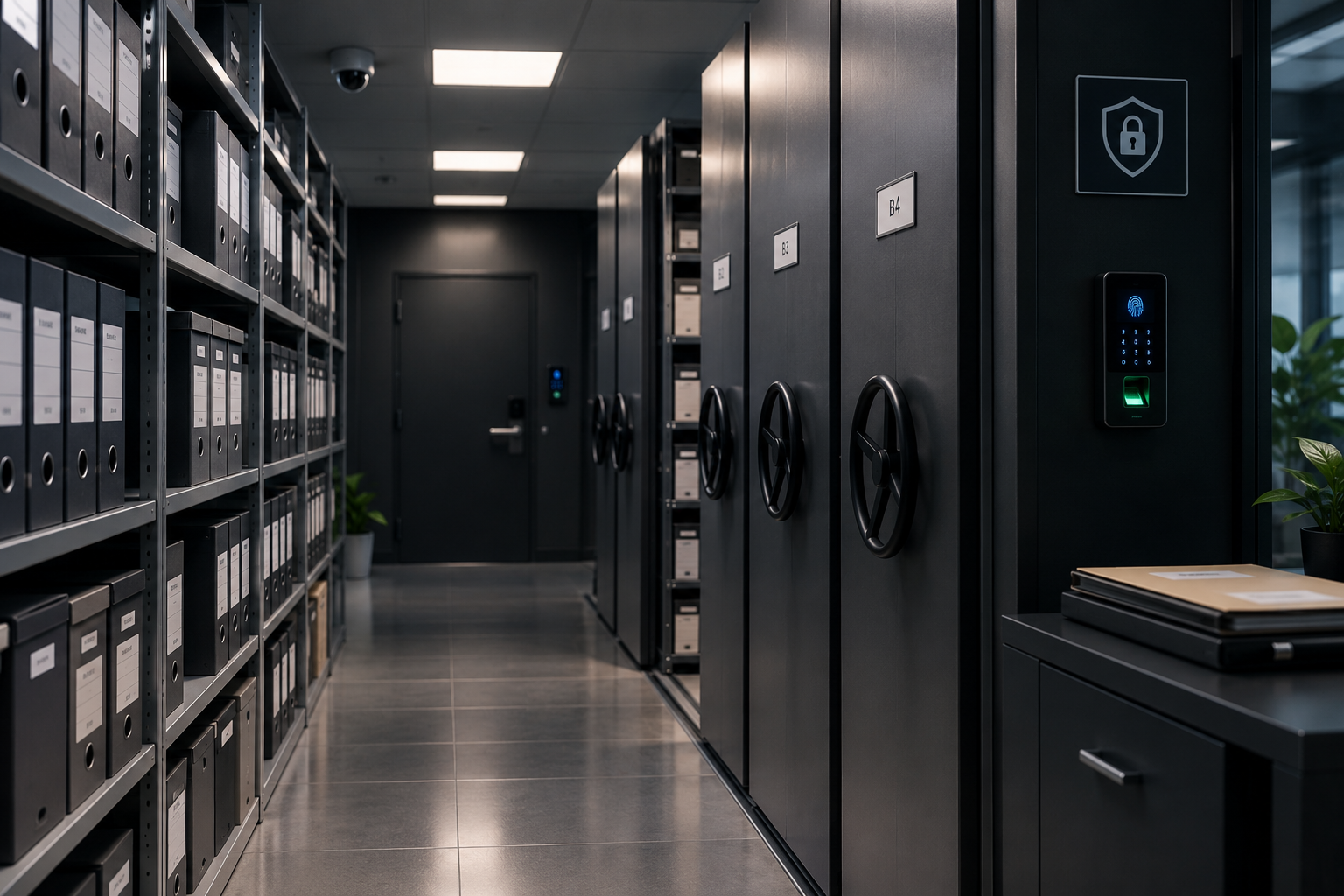
In the day-to-day operations of a company, documents accumulate almost invisibly. Every signed contract, every issued invoice, every payslip, and every set of meeting minutes adds to what already exists, and it is only after several years that the volume becomes truly significant. Some of these documents remain in filing cabinets, others in boxes stored at the back of an office, and still others on computers, external drives, or email accounts, often without anyone having a complete overview of what exists and where it is located.
This situation is common, and it causes no difficulty as long as no one needs to retrieve a specific document. It becomes important during a tax inspection, an audit, a dispute with a customer or supplier, a financing request, or a change in management, in other words whenever the company must prove something using its own records. Secure archiving addresses precisely this need: ensuring that useful information exists, remains intact, and can be retrieved quickly.
What Archiving Means
Archiving is often confused with simple filing. Filing consists of organizing documents used in daily operations, whereas archiving involves managing the preservation of documents whose day-to-day use has ended but whose existence the company must be able to justify for a specified period. This period varies according to the nature of the document. Accounting records, HR documents, contracts, and correspondence are governed by different rules, and every company has an interest in identifying the requirements that apply to it, based on the regulations in force in the country where it operates.
Archiving therefore serves three complementary objectives. It helps comply with legal retention requirements, provides evidence in the event of litigation, and preserves the company's institutional memory, meaning the history of its decisions, commitments, and relationships with partners. A properly archived document remains usable years after its creation, which is not the case for a document that has simply been piled up and stored away.
The Requirements for Reliable Preservation
Paper records withstand the region's climate poorly. Heat, humidity, and temperature fluctuations encourage mold growth, weaken ink, and cause pages to stick together, while insects, particularly termites, can damage entire collections when storage facilities are not properly treated. An archive room must therefore meet several conditions: sound floors and walls, controlled ventilation, protection against fire and water infiltration, suitable shelving, and regular monitoring of the condition of boxes and files.
Digital media have their own limitations, although of a different nature. A hard drive has a limited lifespan, a file can be deleted or overwritten by mistake, and documents stored on a single workstation depend entirely on that computer. For this reason, a single backup cannot be considered sufficient. Standard practice is to maintain several copies on different media, including at least one copy stored in a location separate from the company's premises.
Confidentiality is also a key aspect of secure archiving. Employee records, commercial contracts, and financial data should only be accessible to authorized individuals, and it is useful to be able to trace who accessed which file and when. In a physical archive facility, this involves controlled access and consultation logs; in a digital system, it relies on differentiated access rights and audit trails.
Organizing to Retrieve Information Efficiently
An archive is only as valuable as the ease with which its contents can be retrieved. When filing practices depend on individual habits, they quickly become incomprehensible to anyone other than their creator, and searches become longer as the volume of records increases. A company-wide classification scheme solves this problem by assigning each document category a specific location, indexing method, and naming convention applied consistently across all departments.
This classification scheme is accompanied by a retention schedule, which specifies how long each type of document must be kept and what happens afterward, whether it is destroyed or preserved permanently. Such a schedule prevents two opposite pitfalls: the premature destruction of documents that should have been retained and the indefinite accumulation of valueless records that consume space and complicate searches.
The Role of Digitization
Digitization complements physical archiving without necessarily replacing it. A digitized and properly indexed document can be located within seconds using a name, date, or keyword; it can be accessed simultaneously by multiple users, including remote users; and it can exist in multiple copies. For a company operating across multiple locations, such as between Brazzaville and Pointe-Noire, this shared access represents a significant time-saving advantage.
The quality of digitization, however, depends on the method used. It requires adequate resolution, quality control of every image, consistent naming conventions, indexing that captures the relevant information from each document, and a system capable of managing records over the long term. This is the role of an Electronic Document Management (EDM) solution, which centralizes files, manages access rights, and preserves a history of modifications. As for paper originals, some must be retained because of their evidential value, while others may be destroyed once the digital copy has been validated, as specified in the retention schedule.
The Steps to Implementation
The starting point is an inventory, which involves identifying existing documents, their location, volume, and condition. This makes it possible to identify the most sensitive archives, those on which business operations directly depend, and to determine the order in which they should be processed. The next step is sorting, which separates documents to be retained, records that have exceeded their retention period, and duplicates. This is followed by the creation of a classification scheme and a retention schedule. Only after these stages comes the choice of preservation method: physical storage in a suitable archive facility, digitization, or a combination of both depending on the nature of the records and how the company uses them.
One final factor determines the success of the entire system: employee adoption. An archiving system works when every staff member knows how to name, classify, and store a document, and it deteriorates as soon as these rules are no longer followed. A few simple guidelines, a designated records management contact, and periodic reviews are generally sufficient to keep the system functioning effectively.
Working with a Specialized Service Provider
Implementing this organization internally requires time, appropriate facilities, and a methodology that few companies have the opportunity to develop on their own. A specialized service provider brings this expertise, along with infrastructure specifically designed for document preservation.
OZIE VÖR supports companies in Brazzaville and Pointe-Noire throughout the entire records management chain: auditing existing archives, sorting, classification, digitization, implementation of an Electronic Document Management (EDM) system, and secure storage of physical documents.